
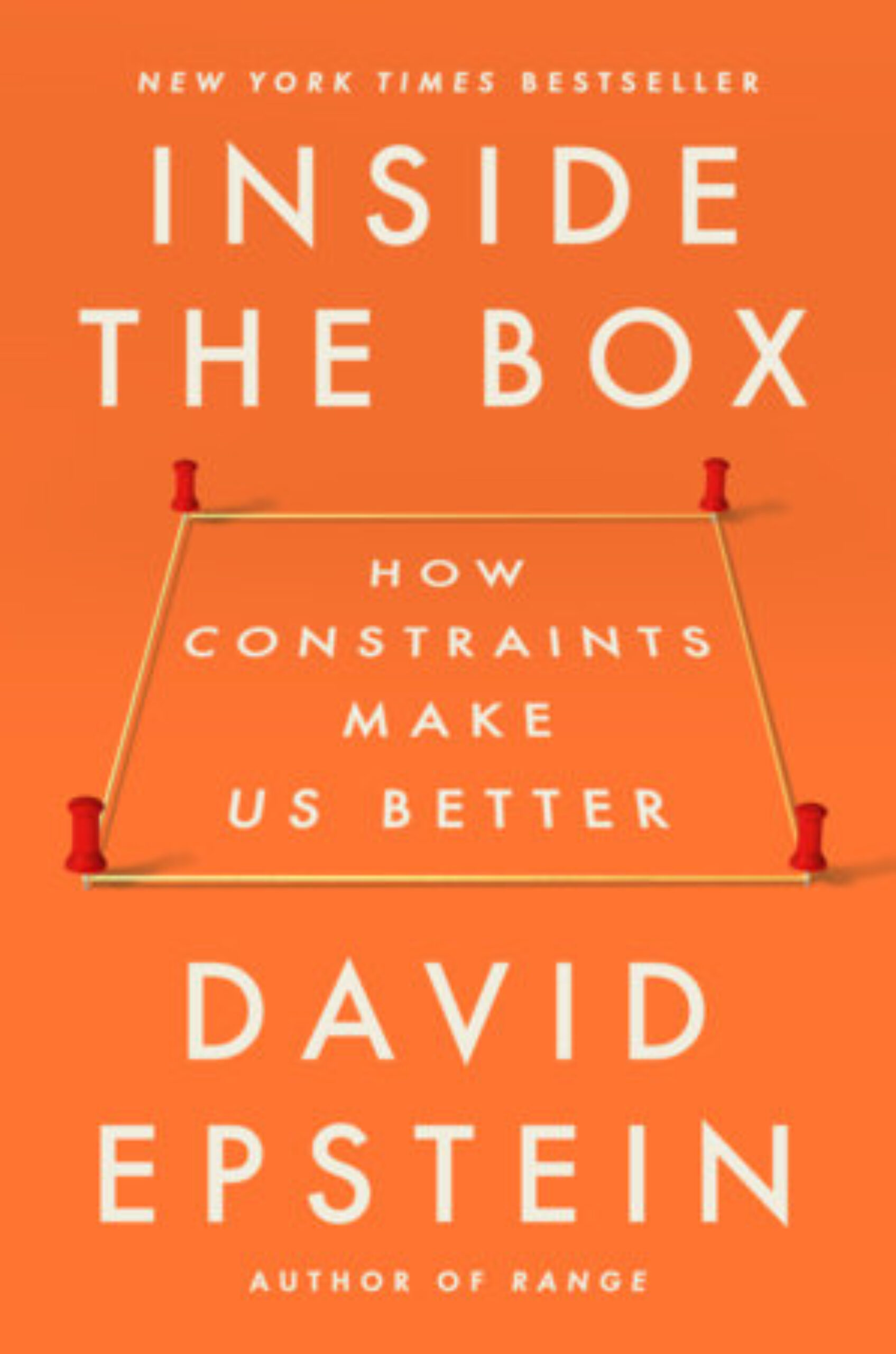
David Epstein’s new book, Inside the Box: How Constraints Make Us Better, has a story that should resonate with most designers. In 1975, Keith Jarrett arrived at the Cologne Opera House to find the wrong piano waiting for him — undersized, tinny in the upper register, sticky in the pedals. He nearly walked out. Instead, he played around the instrument’s failures, leaning on the middle register and rhythmic invention, and produced The Köln Concert, the bestselling solo piano album ever recorded. The broken piano, Epstein argues, did Jarrett a favor: it blocked his habitual moves and forced him somewhere new.
Epstein contends the brain defaults to the path of least resistance. Given total freedom, we reach for the familiar. Rinse-and-repeat designs are the norm. Constraints — the right ones — interrupt that reflex and compel critical thinking. Dr. Seuss wrote Green Eggs and Ham on a fifty-word bet. Bach chose fugues, the most rule-bound form available, and the rules pushed him into harmonic territory he’d never have entered.
Ours may be the only creative discipline where the box is literal. The zoning envelope is usually a box — setbacks, height limits, floor area ratio, and a volume drawn in the air before a single design idea exists. Add the building code, the budget, the soil report, the frost line, the fire separation distances, and the client’s program, and the blank page that terrifies novelists simply never appears on our desks.
But the book’s most useful observation distinguishes between right and wrong constraints. The right ones, Epstein writes, limit the workspace while leaving the explorer free inside it. The wrong ones dictate both the goal and the method, and they kill creativity. Every architect knows both kinds. A tight budget on an affordable housing project is a helpful constraint: it tells you what the building must achieve and then leaves the invention to you. A client who arrives with the plan already sketched, or a review body that prescribes the solution rather than the underlying goal, is the wrong kind. The craft of practice is partly the craft of negotiating wrong constraints back into right ones: converting prescriptive ones like “use this material” into performance ones like “achieve this standard.”
Epstein notes the best creators don’t merely tolerate constraints — they manufacture them. When the external box is too loose, they build their own. A disciplined structural grid, or a palette pared to two or three materials done superbly: these are self-imposed cages, and they are what separate coherent buildings from catalogs of gestures. The hardest commission is often the generous one — the open rural site, the flexible budget, the trusting client — because there is nothing to push against. For these projects, the first task is to invent broken piano keys yourself.
There’s a further parallel in designing for “extreme users” — the insight behind universal design, that solving for the most constrained person typically produces something better for everyone. We’ve seen this in our work when designing schools for students with learning differences. The OXO peeler was designed for arthritic hands but works superbly as a peeler for everyone.
Finally, Epstein’s chapter “The Remix of Everything” dismantles the cult of originality itself, noting that equating creativity with pure novelty is a Romantic-era invention; for most of history, creativity meant transforming, connecting, and borrowing. Architecture has always worked this way. We call it precedent and typology. The courtyard block, the basilica section, the porch — every worthwhile building is a remix of forms tested across centuries, adjusted for a new site, climate, and life. Admitting this isn’t a confession of unoriginality. It’s our discipline’s oldest constraint, and its most generative one.
Epstein argues that the way to think outside the box is to first build a very specific box. The box isn’t where creativity goes to die. It’s where it thrives.