
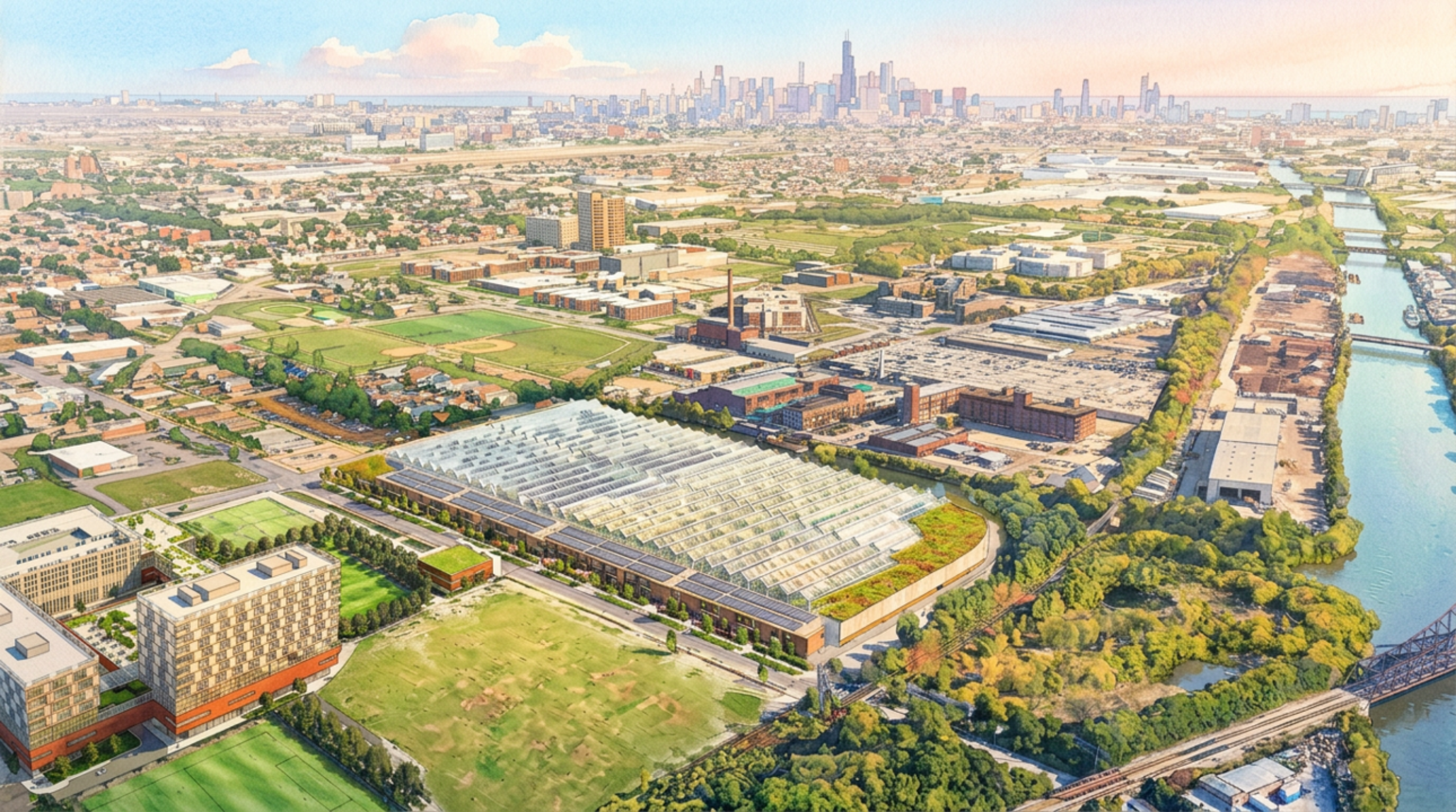
Chicago has always been a food city. It was the place where the prairie’s harvest first met the world — grain elevators, rail yards, and the Board of Trade. Later, it became known as the world’s Candy Capital and its Hog Butcher. Now, even though Chicago is a major produce distribution hub and home to the James Beard Awards, the “Oscars of the Culinary World,” it lacks a place that fully embodies food’s cultural and economic potential.
What is a Food District?
A food district is a place where food is grown, processed, prepared, and enjoyed — often within a single square mile. Rather than a slogan, it’s an established planning concept. Unlike an “agrihood”, which the Urban Land Institute defines as a master-planned housing community with a working farm as its focus, a food district involves other food businesses.
The USDA-funded Food Innovation Districts guidebook defines these districts as geographic concentrations of food businesses and community activities that cities deliberately cultivate, since clustering enterprises amplifies economic returns. Clustering shares infrastructure, knowledge, and customers.
Chicago is already known for processing, preparing, and enjoying food. The missing puzzle piece is commercial-scale growing. If Chicago adds growing to its repertoire, it can prioritize nutrition and taste over transport while creating jobs for residents and vastly improving its self-reliance. Food is also the great unifier — it connects people across income, age, and ethnicity like nothing else.
Growing at the scale that matters
AgriFlats proposes thirteen one-acre, Dutch Venlo-style hydroponic greenhouses on a 17.4-acre brownfield at 31st and Kedzie in Little Village — paired with live-work housing, a learning lab, and cooperative infrastructure. It is not a community garden, nor is it a vertical farm operated by robots. It is proven, ground-level, protected-culture agriculture of the kind that has made the Netherlands the world’s second-largest food exporter, adapted to a Chicago neighborhood that knows food work in its bones.
Three characteristics make building the missing puzzle piece worthwhile.
It’s circular. Each greenhouse operates as an interconnected closed-loop system: boiler and generator heat is captured, CO₂ is recycled into the growing environment, green waste feeds an anaerobic digester that feeds the boiler in turn. Hydroponic production uses roughly 90 percent less water than field-grown vegetables, and produce travels blocks — not thousands of miles — to reach its market.
It’s visible. For a century, the supply chain has made growers and eaters strangers to each other. At AgriFlats, growers live where they work, and neighbors can see their food growing through the glass. Trust is rebuilt the old way: face-to-face.
It’s resilient. The pandemic and the years since taught every city the same lesson — long supply chains are fragile. Year-round protected-culture production means fresh vegetables in February, grown by neighbors, insulated from climate shocks, freight disruptions, and price swings at the border.
The benefits compound
For Little Village, the immediate benefits are concrete: a remediated brownfield returned to productive use, year-round agricultural jobs and training, and fresh produce in communities the grocery industry has chronically underserved. But the district-level benefits are greater than those of any single site.
A completed food district becomes a business incubator ecosystem. An entrepreneur can learn to grow at City Colleges of Chicago’s Arturo Velasquez Institute — home to Windy City Harvest’s training programs — or launch a value-added product at The Hatchery. Distribution partners like The Common Market Great Lakes could then open institutional markets — schools, hospitals, universities — that individual growers could never reach alone. University plant breeders can develop hybrids of culturally significant crops like Aji Dulce peppers, optimized for year-round controlled-environment cultivation.
AgriFlats is explicitly designed for graduation: growers who succeed move on to larger operations, opening their acre to the next cohort. Turnover isn’t a risk; it’s the engine.
The Current Chapter
Chicago fed the nation twice by concentrating food infrastructure in one place and letting proximity do its work. A Food District follows the same logic at neighborhood scale — except this time, the wealth it generates is designed to stay home, in cooperative ownership, in local jobs, in food that never leaves the community that grew it.
The pieces are on the board. The partners are in place. Imagine Chicago in 25 years: “Grown in Chicago” means something, the first AgriFlats graduates are running a regional industry, and the city’s first food district is both an attraction and an economic engine.